Guide · Collegiate Racing
How to start collegiate bike racing in California
From "I'm a student who'd like to race" to your first collegiate start line, with Cal Cycling at UC Berkeley as the example.
The short answer
To start collegiate bike racing in California, find your school's cycling team, check its membership process and the collegiate eligibility rules, join the team's rides, and practice pack skills. Then get a USA Cycling collegiate license and choose a race on the Western Collegiate Cycling Conference (WCCC) calendar in a category you're eligible for. At UC Berkeley, that team is Cal Cycling.
How do you start collegiate bike racing in California?
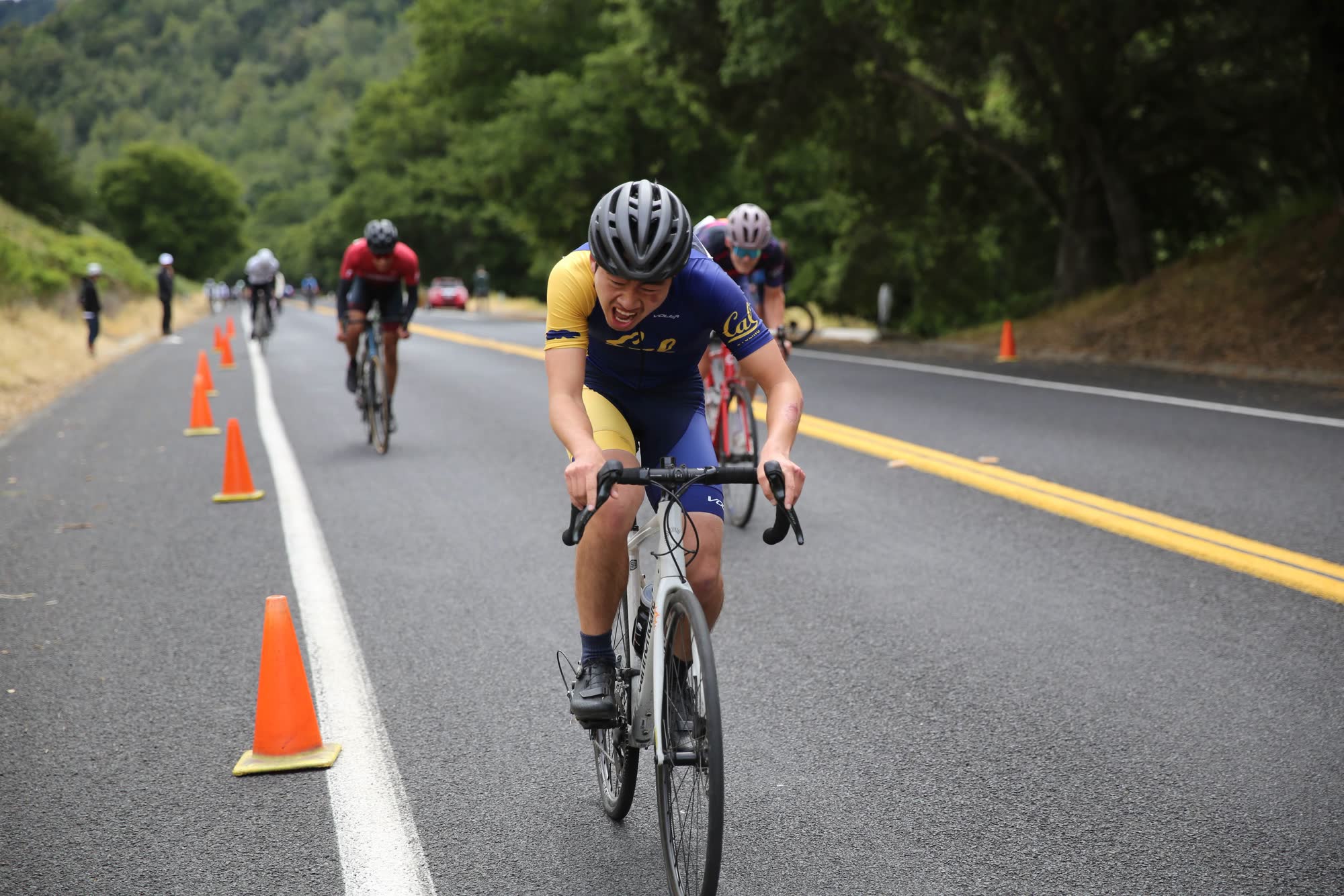
Collegiate cycling is bike racing for college students, run by USA Cycling through regional conferences. In California, western Nevada and Hawaii, that conference is the Western Collegiate Cycling Conference (WCCC). You race for your school's team, against other schools, in fields grouped by category, and your results count toward individual and team standings.
- Find your school's cycling team, usually through campus recreation or club sports.
- Check the team's membership process, and separately check whether you're eligible to race collegiately.
- Join the team's rides that match your experience.
- Learn pack skills: holding a line, cornering in a group, riding close to others.
- Get a USA Cycling collegiate license, registered to your school's team.
- Choose a conference race with a category you're eligible for, and register under your school.
At UC Berkeley, the place to start is Cal Cycling, the university's mountain and road bicycle club and racing team.
Start with Cal Cycling at UC Berkeley
Cal Cycling describes itself as the mountain and road bicycle club and racing team of the University of California, Berkeley, and it races in the WCCC. Its stated mission is to support cyclists at all levels while fielding a competitive racing team, and it says its members range from highly competitive racers to near-beginners. Its race seasons are mountain bike in the fall and road in the spring, with group rides, social events and other club activities in between.
How joining works
- Any registered undergraduate or graduate student at UC Berkeley is eligible to join, according to the club.
- Membership means being on the club's Sport Clubs roster, managed through IMLeagues. The club's test: if you can "purchase" the free Sport Club Membership in the Cal Rec Sports Store, you can join.
- Club activities, including the Saturday group rides, are open to roster members only, so sign up before you show up.
- You don't have to race to join, and the club charges lower dues for non-racing members.
- Members follow the code of conduct in the club's constitution, including riding safely, with a helmet and with respect for other road users, and help volunteer at events the club hosts, such as its home races.
- If sign-ups aren't open yet, the club suggests joining its mailing list to hear when they are.
Questions go to the club at [email protected], and its site links to its Instagram, mailing list and officers. Membership details, dues and the race schedule change, so take them from Cal Cycling directly; this guide is written by the Berkeley Bicycle Club, not by Cal Cycling or UC Berkeley.
Check Cal Cycling's current joining information →
Not a registered student? Cal Cycling points postdocs and recent graduates, who usually can't join, toward local clubs, including the Berkeley Bicycle Club.
Do you need racing experience?
No. USA Cycling describes its collegiate program as open to riders of all skill levels, the WCCC says most teams welcome riders from beginners to national contenders, and Cal Cycling's own membership includes near-beginners. What you do need is a safe bike, enough fitness to finish a team ride, and the willingness to learn how to ride in a group.
It helps to separate three things. Recreational riding is riding with the club for fun and fitness, and plenty of members never race. Team training is structured riding with teammates that builds the fitness and pack skills racing needs. Competition is racing for your school in conference events, which brings its own eligibility and licensing rules.
Fitness alone isn't enough. In a race, riders depend on each other to hold a line, brake smoothly and corner predictably, so practice those skills on group rides first. Cal Cycling asks riders to bring a fully functional bike that's safe in a group, the tools to fix a flat, and enough food and water for the ride.
What is the WCCC?
The Western Collegiate Cycling Conference (WCCC) is the USA Cycling collegiate conference for schools in California, western Nevada and Hawaii, one of eleven collegiate conferences nationwide. It runs the conference calendar of race weekends hosted by member schools, keeps the season's individual and team standings, called omniums, and publishes category and upgrade guidance. Its top riders and teams can go on to USA Cycling's collegiate national championships.
The WCCC's website has the current schedule with registration links, results and standings, category guidance and documents, and USA Cycling's WCCC page lists member schools with their contacts. Our WCCC guide explains how the conference and its scoring work.
For the official calendar, go straight to the source.
Who is eligible to race?
Joining a club and racing collegiately are different things. Cal Cycling's club is open to any registered undergraduate or graduate student, but to race in any collegiate race, USA Cycling's rulebook requires three things:
- Be a full-time student in good standing at the school that will grant your degree, as your school's registrar defines it. Post-doctoral students and fellows aren't eligible.
- Be a member in good standing of the team at that school. You race for the school you attend; composite teams aren't allowed.
- Hold a valid collegiate cycling license, or buy a one-day license. One-day licenses only cover the lowest available category, aren't accepted for the top category, and can't be used at national championships.
Students in their final term who need less than a full course load to graduate can apply for a reduced course load waiver. International students at U.S. schools can race for their school with a collegiate license. Graduate students are covered by the same full-time rule as everyone else. If your situation is unusual, ask your team's officers or the WCCC conference director before you register.
Collegiate categories explained
In the WCCC, your collegiate category follows your USA Cycling license. The conference says its categories and upgrade criteria align with non-collegiate racing, and its standings group road riders by their current license category: Pro/1/2 together, then Categories 3, 4 and 5, with separate women's and men's or open standings. A new racer starts in the lowest category, often listed as Novice.
It isn't a simple conversion everywhere. USA Cycling's collegiate policy still describes lettered categories, A through E, with placement based on your USA Cycling category and points, and some race listings use letters: Berkeley has listed a Collegiate B field alongside numbered collegiate fields. Check each race's listing and ask your team if you're unsure which field is yours.
WCCC categories and upgrades →
Collegiate results can earn USA Cycling upgrade points when the race meets the usual requirements, such as field size, and you request upgrades through your USA Cycling account. Our category guide explains the numbers, field labels and upgrade rules.
What kinds of races can students enter?
Collegiate cycling covers road, mountain bike, cyclocross, track, gravel and BMX nationally. Cal Cycling races two seasons, mountain bike in the fall and road in the spring, and the WCCC also lists track, cyclocross and gravel events and national championships.
- Road races: longer races on open or closed roads, often with climbing.
- Criteriums: short, fast laps of a closed course, where collegiate races include sprints for bonus points.
- Time trials: individual and team races against the clock.
- Mountain bike: cross-country and short-track endurance races, plus gravity events such as downhill.
Many collegiate road races run alongside open races, with collegiate and open riders on the course together and scored separately. Collegiate riders register under their school's team so their results count for it.
What equipment and budget do you need?
Essentials
- A safe, mechanically sound bike for your discipline. Cal Cycling doesn't have team bikes, but says it can help you search for one.
- A helmet that meets USA Cycling's standards.
- Mass-start legal equipment: collegiate racing allows no aero equipment, such as aero bars, disc wheels or tri-spoke wheels, and wheels need at least 16 spokes.
- Your school's team kit, or a plain jersey.
- Bottles, a spare tube, tire levers and a pump or inflator.
Upgrades that can wait
Lighter wheels, a power meter and other upgrades can come later. A reliable bike and good pack skills matter far more in your first season.
What it costs
Plan for club dues, a USA Cycling collegiate license, race entry fees, team kit, and travel, lodging and food on race weekends. Amounts vary by school and season, so check your team's current figures. Cal Cycling's membership page says the club pays for transportation, housing and part of race fees for its members racing in the WCCC; confirm the current details with the club.
Prepare for your first collegiate race
- Ride with the team: group rides are where you learn to ride close to others, and where teammates can tell you which race suits a first-timer.
- Practice skills: cornering, holding a wheel and riding predictably at speed.
- Research the course: the race listing, the map, and teammates who've raced it.
- Check your bike a few days before: tires, brakes and shifting.
- Practice fueling on long rides, so race day isn't the first time you eat on the bike.
- Register in the right category, under your school's team, with your collegiate license ready.
- Read the race-day instructions: check-in, start times and any course rules.
Our first-race guide covers the rest: what to pack, a race-day timeline, and what the racing feels like.
Balance racing with student life
Racing is meant to fit around school, not the other way around. You don't need to race every weekend to be part of the team or to improve.
- Look at the conference schedule next to your academic calendar, and pick races that don't collide with exams or big deadlines.
- Train consistently in small blocks; short rides on busy weeks still count.
- Protect sleep and recovery. They matter as much as the training itself.
- Plan travel early: race weekends can mean early starts and long drives, so share rides with teammates.
- Set a budget for the season before it starts, and ask your team what it covers.
The best part of collegiate racing often happens off the bike: the carpools, the shared meals, cheering teammates in other fields, and friends you'll keep riding with long after graduation.
How the Berkeley Omnium fits into the journey
The Berkeley Omnium is two races in one weekend: the Berkeley Hills Road Race on the Three Bears near Orinda, and the Berkeley Streets Criterium in downtown Berkeley. It's a good place to see how three different things work:
- On the collegiate calendar: the WCCC's most recent road schedule listed UC Berkeley's race weekend as the Berkeley Omnium.
- Collegiate fields: the most recent Berkeley race information listed collegiate fields alongside the matching open fields, such as Collegiate P/1/2 with the P/1/2 race, scored separately.
- An open field: any licensed rider, student or not, can enter an open field that matches their USA Cycling category. That's regular racing, and it doesn't count toward collegiate standings.
Cal Cycling has also helped build the weekend: Preston Mui led the criterium effort from Cal Cycling as the Berkeley Omnium took shape, and Nicolas Goumas and Adrian Chin, also from Cal Cycling, have led it since.
Collegiate racing at the Omnium →
Whether the next edition will be on the conference calendar, and which collegiate fields it will offer, hasn't been announced. Check the race pages and sign up for updates rather than assuming last edition's options.
Explore the courses now: the climbing of the Berkeley Hills Road Race and the corners of the Berkeley Streets Criterium.
What if you attend another California college?
Start with your own school. Search its campus recreation or club sports pages for a cycling club or varsity team, and check USA Cycling's WCCC page, which lists member schools from Cal Poly Humboldt to San Diego State with a contact for each.
USA Cycling: WCCC member schools →
Most collegiate teams are clubs: student-run, funded by dues, fundraising and campus club sports resources. Varsity teams are school-funded programs that may offer coaches and scholarships. Both race in the WCCC.
No team at your school? You can start one. USA Cycling's guide walks through registering with your club sports office, contacting the conference director and registering the club with USA Cycling, and USA Cycling waives the club fee for a new club's first year. You must race for the school you attend, so a new club is the way to race if your school doesn't have one.
Your next step
At UC Berkeley, visit Cal Cycling to learn how to get involved: join the mailing list, sign up when membership opens, and come to a ride.
Visit Cal Cycling to get involved →
Then explore the Berkeley Omnium's race information: two courses, one weekend, and a field for almost every rider.
Questions
How to start collegiate bike racing in California: FAQ
Do I need racing experience to join a college cycling team?
No. USA Cycling's collegiate program is open to riders of all skill levels, and teams such as Cal Cycling at UC Berkeley include near-beginners. You'll need a safe bike and should learn group-riding skills before you race.
Who is eligible to race collegiate cycling?
Full-time students in good standing at the school that will grant their degree, who are members of that school's team and hold a USA Cycling collegiate license (or a one-day license for the lowest category). Postdocs aren't eligible.
USA Cycling collegiate FAQ →How do I join Cal Cycling at UC Berkeley?
Any registered UC Berkeley undergraduate or graduate student can join. Cal Cycling's membership page has the sign-up form and mailing list, and members are added to the club's Sport Clubs roster. Group rides are for roster members, and you don't have to race to join.
Check Cal Cycling's current joining information →What license do I need for collegiate racing?
A USA Cycling collegiate license, registered to your school's team. A one-day license can be used for the lowest available category, but not for the top category or at national championships.
USA Cycling collegiate cycling →What category will I race in?
In the WCCC, your collegiate category follows your USA Cycling license category, grouped as Pro/1/2, 3, 4 and 5 on the road. New racers start in the lowest category.
Cycling categories explained →How much does collegiate cycling cost?
Costs include club dues, a collegiate license, race entries, kit, and travel and lodging. They vary by school, and some teams cover part of them: Cal Cycling says it pays for transportation, housing and part of race fees for its racing members. Check your team's current details.
How do I find collegiate races in California?
The Western Collegiate Cycling Conference (WCCC) publishes the official schedule, with registration links, on its website. Your team will also share which races it's attending.
WCCC race schedule →