Guide · First Race
Your first bike race: everything you need to know
What to check before you register, how to spend the last week, what happens on race day, and what a successful first race really looks like.
The night before your first race, you'll probably check your tire pressure twice, pack your bag three times, and lie awake wondering whether you belong out there. You do. Almost every racer on the start line has had that night.
This guide is about the race itself: what to check before you register, the last week, what to pack, how race day unfolds, what the racing feels like, and what to do when it doesn't go to plan. If you're still deciding whether to race at all, our beginner's guide covers the bigger picture; this one picks up where it leaves off.
The short answer
Before your first bike race, choose a field you're eligible for (usually Novice for new racers), get the USA Cycling license the race requires, make sure your bike is mechanically sound, and practice riding close to others on group rides. Read the race information carefully, pack the night before, and arrive with enough time to check in, pin your number, warm up and reach staging calmly. A successful first race is about riding safely and learning, not where you finish.
What should you know before your first bike race?
Most first-race stress comes from small unknowns: which field, which license, where to park, when to line up. Settle them ahead of time and race day gets much simpler.
- Choose an eligible field: usually Novice for new racers, or an age-based junior or masters field you qualify for.
- Confirm your license: a one-day license covers many Novice fields, but check what the event accepts.
- Prepare your bike: brakes, tires, shifting and plugged handlebar ends, checked days in advance.
- Practice riding with others: group rides where you hold a wheel and corner in a bunch.
- Study the event instructions: check-in location and hours, start time, course and any special rules.
- Arrive early: enough time to park, check in, pin your number, warm up and reach staging without rushing.
Are you ready to race?
You're ready when you can ride the race distance and ride predictably in a group. Fitness matters, but so do pack skills, because in a race other riders' safety depends on yours, and yours on theirs.
- Hold a line: ride straight, and keep the same line through a corner as the riders beside you.
- Brake predictably: smoothly and early, never a sudden grab with riders on your wheel.
- Corner calmly: pick your line before the turn and stay on it.
- Ride near others: relaxed elbows and shoulders, and never overlap the wheel in front of you.
- Follow instructions: from officials, marshals and the pre-race briefing.
No fitness number guarantees you'll stay with the group, and getting dropped in a first race is common. If group riding still feels uncomfortable, give it a few more weeks of group rides or find a skills clinic first. At the Berkeley Omnium, new racers have had a Beginner Race Program on the criterium course before racing begins.
Choose the right event and category
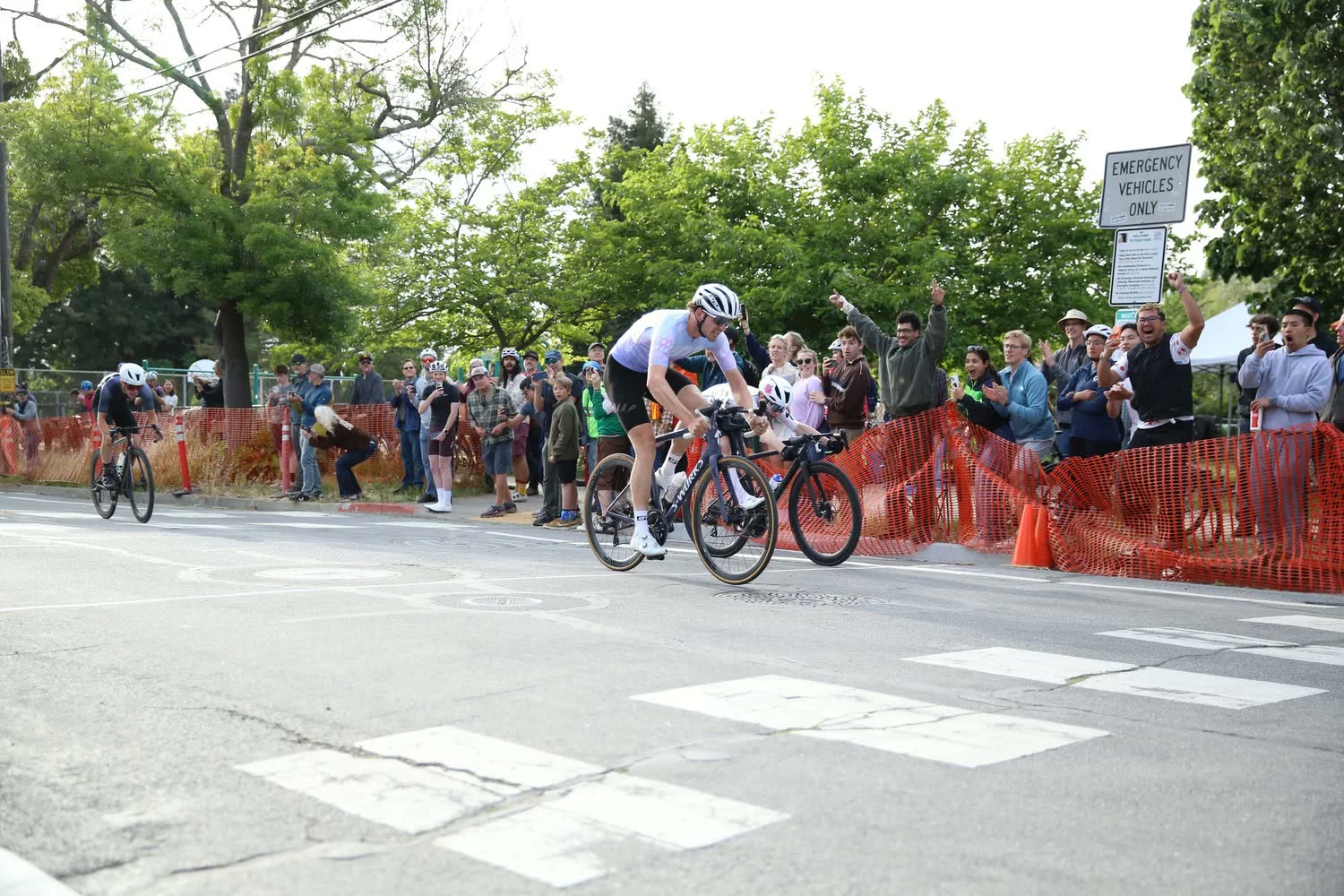
A road race is a longer race on open roads, often with climbing, where the field breaks apart over time. A criterium is a shorter race of many laps on a closed course, where the bunch stays together and the corners come every lap. At Berkeley that contrast is the whole weekend: the Berkeley Hills Road Race climbs the Three Bears near Orinda, and the Berkeley Streets Criterium races short laps beside Ohlone Park. Neither is automatically the easier first race; choose the one that suits your skills.
Under USA Cycling rules, new road racers start in the Novice category. Not every event offers a Novice field, and fields are sometimes combined, so read the event listing for each field's name, eligibility and distance or duration.
How to read categories and field labels →
Women, juniors and masters
Women's fields are often combined, such as a 4/Novice field; at Berkeley, the criterium has had a Women's 4/Novice field and the road race a short and a long course for women. Juniors, riders with a racing age of 9 to 18, race age-group fields, and at Berkeley a parent or guardian has had to be present to sign the waiver for riders under 18. Masters fields are grouped by age, and some include Novice riders.
Looking for an event with a field that fits? The Northern California racing calendar lists the upcoming dates we've verified with organizers.
Registration and licensing, step by step
- Check eligibility: your category, age group and gender against the event listing.
- Select the right field when you register, usually on BikeReg. If two fields could fit, the listing's notes or the organizer can tell you which.
- Get the license the race requires. USA Cycling sanctioned races need an annual or a one-day license. USA Cycling limits the regular one-day license to the lowest category, Novice; former members can buy an experienced one-day license online; and one-day licenses can't be used at championship events.
- Complete the waivers. You accept a liability release when you buy a license or register, and riders under 18 may need a parent or guardian to sign.
- Read your confirmation for check-in location and hours, start time, parking, and anything to bring, such as a one-day license receipt.
Missed pre-registration? Some races offer day-of registration, usually for an extra fee; the Berkeley Omnium has offered it with a surcharge and without cash payments. Don't count on it, though: fields can fill.
What equipment do you actually need?
Less than you might think. A reliable bike matters far more than an expensive one.
Essentials
- A helmet that meets USA Cycling's standards, worn securely fastened whenever you're participating in the event. The Berkeley Omnium has required ANSI or Snell certified helmets.
- A mechanically sound road bike with plugged handlebar ends and no aero bars, which aren't allowed in mass-start races.
- A cycling jersey and shorts; jerseys are required in USA Cycling races.
- Bottles and cages that hold them firmly over bumps.
- Repair basics for road races, where support is often limited: a spare tube, tire levers and a pump or inflator.
- Clothing for the weather: layers for a cold start, and a rain jacket if the forecast calls for it.
Nice to have
- Spare wheels to leave in the pit at criteriums that allow a free lap.
- A power meter or heart-rate monitor, for learning about your effort afterward.
- Lighter or more aerodynamic wheels, which help far less than practice does.
Before assuming a piece of equipment is allowed, check the race information and USA Cycling's rulebook.
Your final week
You can't build meaningful fitness in the last few days, but you can arrive tired. Aim for rest, routine and readiness.
- Rest: shorter rides than usual, with a couple of short efforts so your legs stay sharp, and more sleep.
- Familiar meals: eat the way you normally do. Race week isn't the time for new foods.
- Hydration: drink normally through the week, and more if it's hot.
- Bike check early in the week, so a worn tire or a sticky shift is a fix, not a crisis.
- Course review: the map, the route on Strava, and for the Berkeley Hills Road Race a course pre-ride video.
- Travel: your route, parking or transit, and a carpool if your club is going.
- No experiments: no new saddle, shoes, tires or gels, and no big training days to cram in fitness.
Racing the Berkeley Hills Road Race? Its preparation guide goes deeper on race week and race morning.
What to pack
- License or one-day license receipt, and your registration confirmation.
- Helmet, shoes, kit, gloves and glasses.
- Layers: arm warmers, a vest, and a rain jacket if needed.
- Safety pins for your number.
- Full bottles, plus extra water. Some courses, like the Berkeley Hills Road Race, have no running water.
- Race food you've tested, and a backup breakfast.
- Floor pump, basic tools and a spare tube.
- Spare wheels for a criterium with a free lap.
- Towel, wipes and sunscreen.
- Warm clothes for after the race, plus food and a drink for recovery.
- Phone, ID and a card or payment app; some races don't take cash at registration.
Race-day walkthrough
Here's an illustrative timeline, counted back from your start. Check-in hours, staging times and rules vary by event, so the race information always has the final word.
- About 90 minutes before: arrive and park, or come by transit.
- About 75 minutes before: check in at registration with your license and confirmation, sign anything required, and collect your number.
- About an hour before: pin your number exactly where the officials or race information say, then check your bike and find the restroom.
- From about 45 to 20 minutes before: warm up, wherever the race allows it.
- About 15 minutes before: go to staging, the assembly area where riders line up before the start.
- Just before the start: listen to the officials' briefing on the course, the finish and any neutral start.
At the Berkeley Hills Road Race, racers have staged in the Orinda BART parking lot and ridden an escorted neutral start, a controlled ride behind officials, out to the start line; warming up on the course hasn't been allowed. At the Berkeley Streets Criterium, check-in has closed 15 minutes before each race, and street parking is limited, so transit or carpooling helps; Downtown Berkeley BART is about half a mile from the start-finish.
What the race will feel like
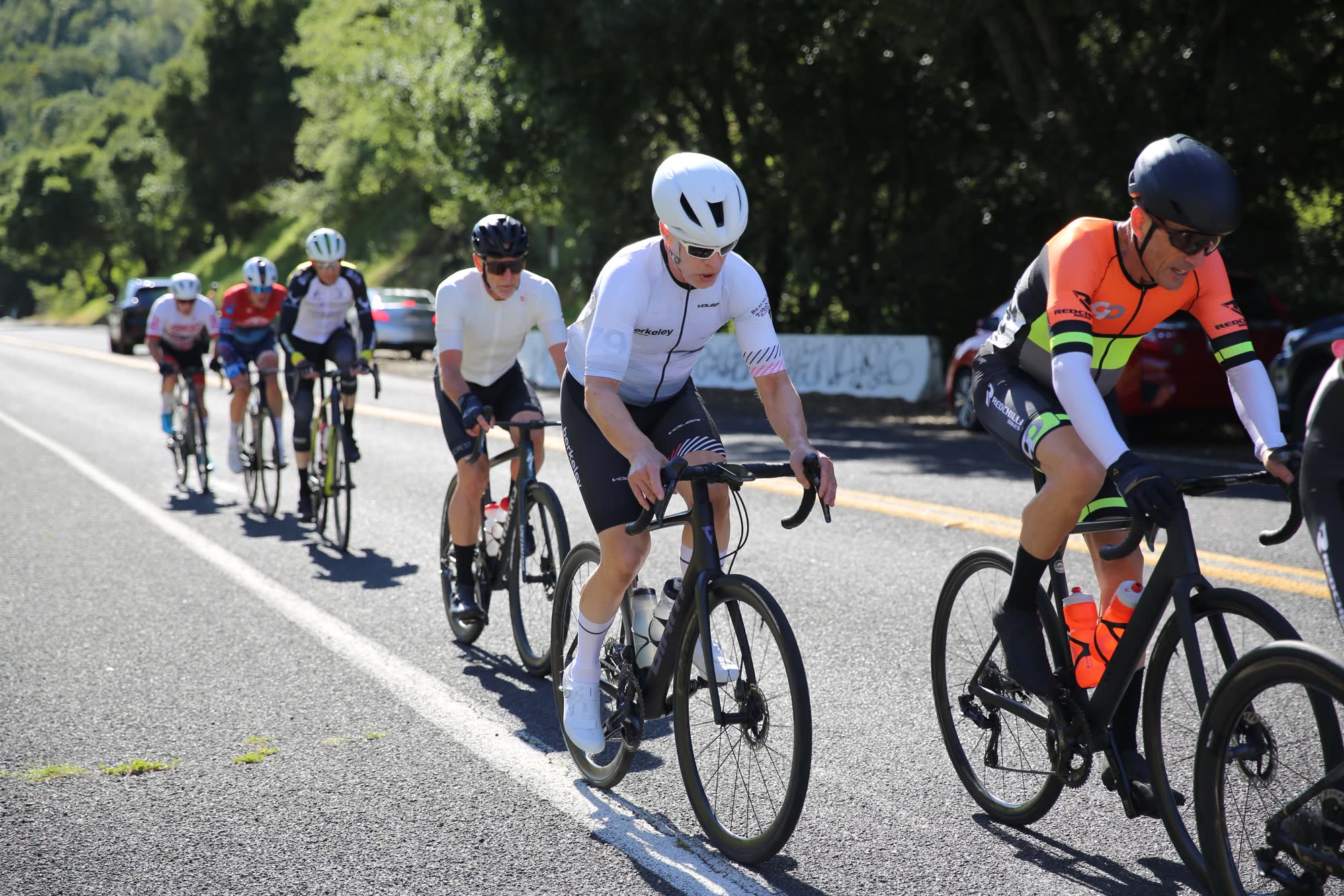
The first few minutes are the strangest: nerves, a crowded start, and a pace that jumps and settles without warning. Surges, sudden accelerations when someone attacks or the field reacts, are normal. So is riding closer to other people than you ever do on a group ride.
- Stay predictable: hold your line, especially through corners, and move gradually after a look over your shoulder.
- Conserve: stay in the draft and let most moves go. Plenty of them come back on their own.
- Never overlap wheels: if the rider in front moves sideways while your front wheel overlaps theirs, you go down.
- Position calmly: somewhere in the middle, out of the very back where gaps open, without fighting for the front.
- Relax: loose arms and shoulders absorb bumps and nudges; tension turns them into swerves.
- Speak up: a calm "on your left" or "slowing" helps everyone.
Safety and the officials' instructions come before any place in the race. If a marshal signals, an official waves a flag, or a crash happens ahead, slow down and follow instructions; there will be other races.
If you get dropped, puncture or can't finish
Getting dropped, losing contact with the group, happens to most new racers at some point. It doesn't mean you don't belong; it tells you where the race was hard. What happens next depends on the type of race and its rules.
If you're dropped
Keep riding at a pace you can hold, and team up with others in the same spot. On open roads, such as the Berkeley Hills Road Race course, which hasn't been closed to traffic, obey traffic laws. If faster groups or the leaders come past, let them through without joining in.
Punctures and mechanicals
In road races, support varies by event; the Berkeley Hills Road Race hasn't allowed wheel support on the course, so a flat usually ends the race, and your spare tube gets you home. In criteriums, USA Cycling rules allow one free lap for a recognized mishap, a legitimate fall, a puncture or a broken essential part, unless the race announcement says otherwise. Repairs must happen in the official pit, a referee decides whether the lap is granted, and you must re-enter before the final 8 kilometers. The Berkeley Streets Criterium has offered a free lap.
Pulled or unable to finish
In criteriums, officials may pull riders who fall too far behind or get lapped. It isn't a penalty; it keeps the course safe and the race running. Lapped riders can only stay in when the officials allow it. If you stop for any reason, tell an official or the registration table so nobody goes looking for you.
Fueling and hydration basics
Match your fueling to the race length and the weather, and stick with what you've practiced. For a short criterium, a familiar meal a few hours before and a bottle may be all you need; feeding from the roadside isn't allowed in criteriums unless the chief referee authorizes it. For a longer road race, start eating early, in small, regular amounts of carbohydrate you've tested in training, and carry enough to drink for the distance and the heat.
At the Berkeley Hills Road Race, bring your own water: there's been no running water on the course, though a feed zone near the bottom of Papa Bear has had neutral water support. There's no single right amount to eat or drink for everyone; your practiced routine is the best guide.
Fueling for the Berkeley Hills Road Race →
After the race
- Cool down with some easy spinning if there's a safe place for it, away from the course while others are still racing.
- Eat and drink something soon, and put on warm clothes.
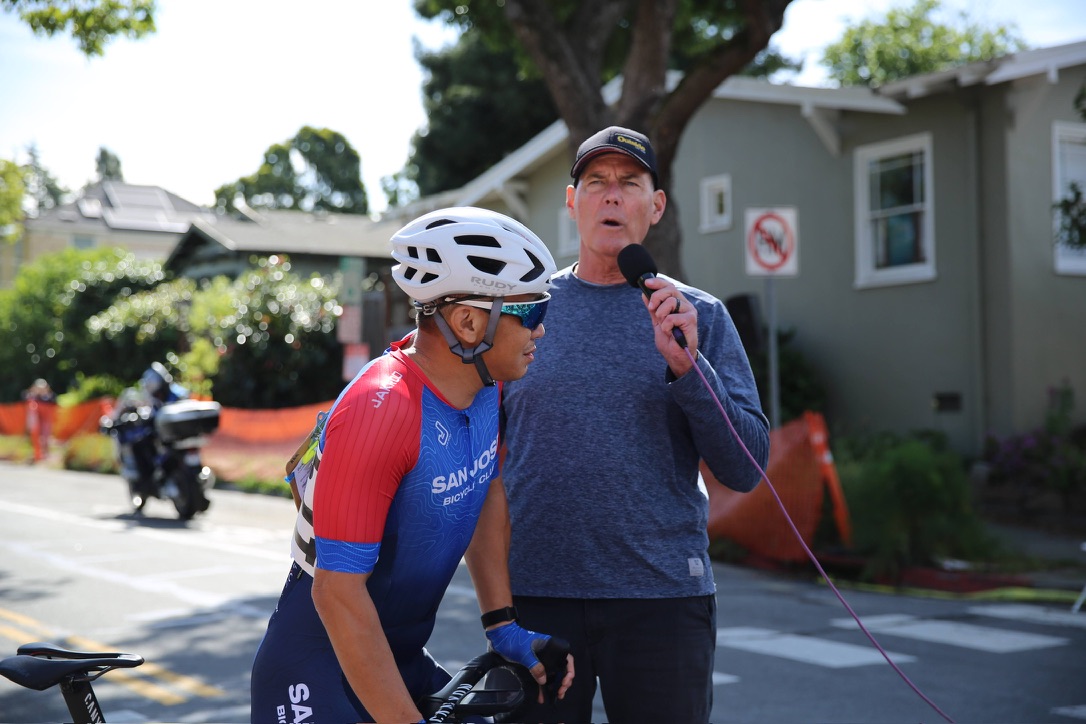
- Check the results. Many races post them online; Berkeley Omnium results have been posted on OnTheDay.
- If a result looks wrong, tell the officials right away: USA Cycling rules give 15 minutes after results are announced to protest final results.
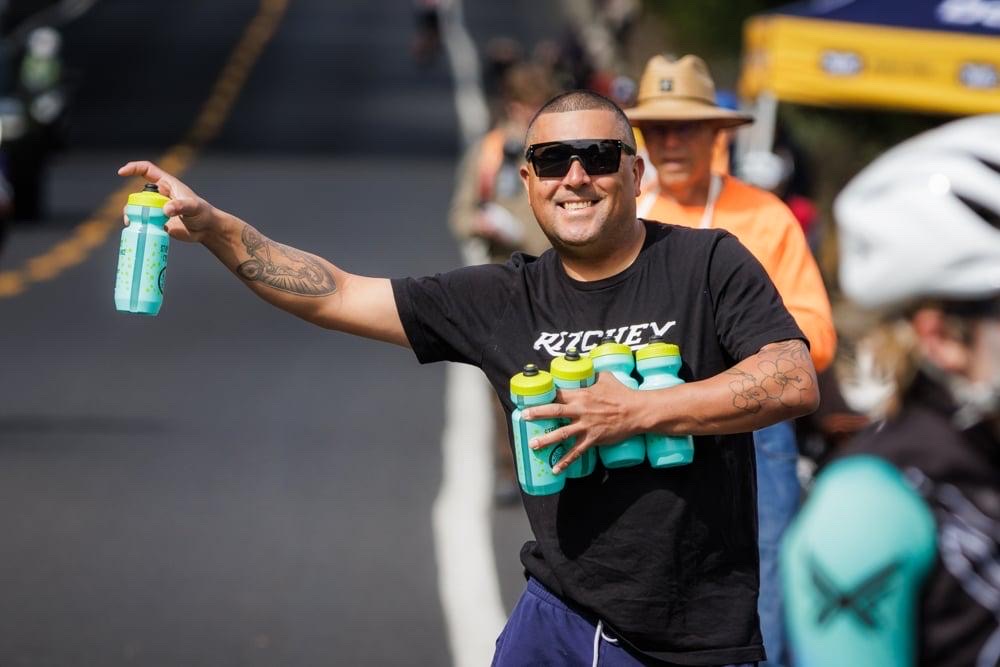
- Thank the volunteers and officials. Races only happen because people give their time.
- Write down what went well and one thing to practice.
You do not need to win your first race to have a successful first race. A good first race means you prepared well, rode safely and predictably, learned how the bunch moves, and made smart choices when it got hard, whether you finished in the group, on your own, or knew when to stop. If you're already thinking about the next one, it went well.
Your first race at the Berkeley Omnium
The Berkeley Omnium pairs two very different first-race options. The Berkeley Hills Road Race asks for climbing, steady pacing and confident descending over the Three Bears. The Berkeley Streets Criterium asks for cornering, positioning and repeated accelerations on a short downtown course. Look at both, then pick the one that suits you.
The Berkeley Hills Road Race →
The Omnium has offered fields for new racers, including Novice and Women's 4/Novice fields, plus junior and collegiate fields, and the Novice races have been 33 miles on the road and 30 minutes in the criterium. You can enter one race or both; to be scored in the overall omnium, you start both races in your category. Confirm the current fields, distances and schedule in the race information before you choose.
The Berkeley Streets Criterium →
Juniors and their families will find the club's junior program on our juniors page, and college riders can see how collegiate racing works at the Omnium.
Racing for a college team? Collegiate fields have raced alongside the matching open fields.
Find your field
Explore the Berkeley Omnium's race information, look at both courses, and choose the field that fits where you are now. Follow the race for registration news, and when it opens, register early, read your confirmation, and pack the night before. We'll see you at the start line.
Questions
Your first bike race: everything you need to know: FAQ
What should I expect at my first bike race?
Check-in, pinning your number, a warm-up and a short wait in staging, then a nervous, crowded start with surges and close riding. Many new racers get dropped at some point, and that's normal. The goal of a first race is to ride safely and learn.
How early should I arrive for my first bike race?
Plan on arriving about an hour and a half before your start, so you can park, check in, pin your number, warm up and reach staging without rushing. Check the event's check-in hours too: some close registration shortly before each race.
Can I get a free lap if I crash or puncture?
In criteriums, usually yes: USA Cycling rules allow one free lap for a legitimate fall, puncture or broken essential part, unless the race announcement says otherwise, with repairs in the official pit. Road races don't have free laps.
USA Cycling rulebook →Where does my race number go?
Wherever the officials or the race information tell you. Placement varies by race, so check before you pin, and make sure the number is flat and readable.
What should I eat before my first race?
A familiar, carbohydrate-rich meal you've eaten before hard rides, early enough to digest before your warm-up. Race day is not the day to try new food.
Is it normal to be nervous before a first race?
Completely. Almost everyone is. Preparing the things you can control, like your field, license, bike, packing and arrival time, leaves fewer surprises and makes the nerves easier to handle.