Criterium Racing 101
Your first criterium race: everything you need to know before the start
Your first criterium will feel fast. That's okay.
You've pinned on a number. There are barriers around the course. Someone is announcing names over a loudspeaker. Riders are warming up, officials are calling categories, and a bell rings. Everyone seems to know where they're supposed to go except you, and you're wondering what you signed up for.
A criterium looks complicated from the outside, but the basic idea is simple: a group of racers rides a short, closed circuit for a set time or number of laps, and when the race reaches its final lap, the first eligible rider across the finish wins. The hard part isn't the rules. It's riding efficiently and predictably while everything around you happens quickly. Here's what to know before you line up.
First crit? Start here.
- Before race day
- Register, check your license and category, make sure your bike works, learn the course, read the schedule.
- Race morning
- Arrive early, check in, pin your number correctly, pre-ride when it's allowed, warm up, know where staging is.
- During the race
- Ride predictably, look ahead, protect your front wheel, hold your line, don't panic when someone gets close, listen to officials.
- Your goal
- Race safely, learn, finish if you can, and come back to race again.
The short answer
A criterium, often called a crit, is a bicycle race held on a short circuit that racers complete repeatedly. It rewards fitness, positioning, cornering, drafting, bike handling, repeated acceleration and race awareness. First-time criterium racers should focus on riding predictably, protecting their front wheel, looking ahead through the field, staying in control through corners and following the officials' instructions, rather than on winning.
What is a criterium?
A criterium, or crit, is a bicycle race on a relatively short circuit that racers ride again and again. Under USA Cycling rules, the course is closed to traffic and between 800 meters and 5 kilometers around. Instead of seeing riders once or twice, as on a road race course, you pass the same places every lap. Crits are known for:
- Corners, every lap.
- Repeated accelerations and high speeds.
- Close group riding.
- Attacks and breakaways.
- Primes, lap cards and final-lap tactics.
- Field sprints to the finish.
Heard the announcer call a prime and wondered what it meant?
How is a crit different from a road race?
| Compared on | Criterium | Road race |
|---|---|---|
| Course | A short circuit | A longer course or loop |
| Corners | Frequent | Usually fewer |
| Accelerations | Out of every corner | Depend on the terrain and the tactics |
| Spectators | See racers every lap | See racers a few times |
| Positioning | Extremely important | Important, in a different way |
| How it feels | Fast, tactical, repetitive | Terrain, endurance and tactics |
The Berkeley Omnium has one of each: the Berkeley Streets Criterium is a short, technical four-corner circuit of about 0.6 miles beside Ohlone Park, and the Berkeley Hills Road Race is a long loop over the Three Bears climbs.
The Berkeley Streets Criterium →
Curious about the other half of the weekend?
Do you need a huge FTP to race a criterium?
No. Fitness matters, but a criterium isn't an FTP test, and no power number decides whether you can start racing. How you do depends on a mix of:
- Aerobic fitness.
- Repeated acceleration.
- Positioning.
- Cornering.
- Drafting.
- Bike handling.
- Race awareness.
- Saving energy.
A very fit rider can still waste huge amounts of energy braking, accelerating and riding out of position. Your watts matter. Where you spend them matters more than most first-time racers expect.
Your first goal: be predictable
New racers sometimes think they need to prove they belong by being aggressive. They don't. The most important thing is being predictable:
- Hold your line.
- Avoid sudden sideways movements.
- Don't brake hard unless you have to.
- Look before you change position.
- Listen, and communicate.
- Don't dive into spaces that aren't there.
- Keep both hands ready to control the bike.
- Follow the officials' instructions.
The riders around you don't need you to be fearless. They need you to be predictable.
What does "protect your front wheel" mean?
Your front wheel is what keeps you upright. If it's alongside another rider's rear wheel and that rider moves sideways into it, they'll usually stay up while you go down. Protecting your front wheel means:
- Avoiding unnecessary overlap with the wheel ahead.
- Giving yourself room.
- Looking ahead, not at the tire right in front of you.
- Anticipating how the group will move.
- Holding a predictable line.
These are skills you learn by practicing with coaching and in group rides. At Berkeley Streets, the Beginner Race Program covers them on the actual course.
Stop staring at the wheel in front of you
Train your eyes to look farther up the road and through the group. Looking ahead shows you the corners coming, riders braking or slowing, attacks, gaps opening, changes in pace, hazards, and movement through the field.
If the first time you notice the field slowing is when the rider directly in front of you brakes, you're reacting too late.
You don't win a crit by winning every corner
First-time racers often worry most about cornering. Good criterium cornering is smooth, predictable and aware, not brave:
- Look through the corner, to where you're going.
- Control your speed before the turn.
- Avoid sudden braking in the middle of the corner.
- Hold a predictable line.
- Remember the riders around you need room too.
- Accelerate smoothly as the road opens up.
Practice cornering before you try anything ambitious in a race. Racing moves come later.
Why corners make crits hard
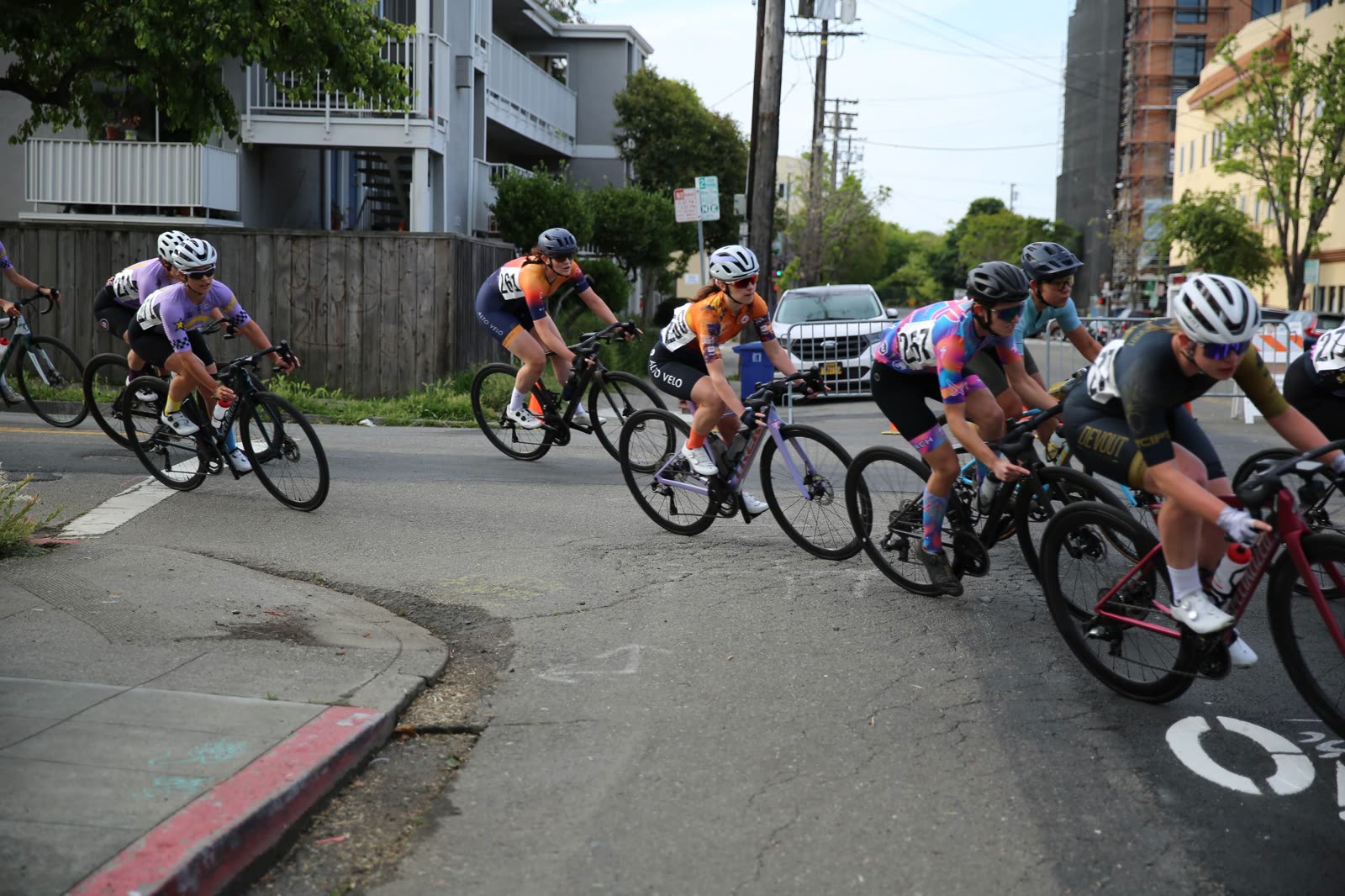
Brake. Accelerate. Brake. Accelerate. Do that dozens of times and it gets expensive. Experienced racers carry momentum through corners more efficiently, so they spend less getting back up to speed.
The cheapest acceleration is the one you never had to make.
What is the accordion effect?
When a field goes through a corner, the slowdown grows from front to back, like an accordion squeezing and stretching:
| Through each corner | Front of the field | Back of the field |
|---|---|---|
| Slowdown | Small | Larger |
| Gaps | Rarely open | Often open |
| Acceleration | Small | Hard, to close the gap |
| Every lap | Repeat | Repeat, and it adds up |
That's why a criterium can feel brutally hard even when it's flat, and even when your average speed or power doesn't look extraordinary afterward.
Why everyone keeps trying to move forward
The accordion is the reason riders try to stay reasonably well positioned. But moving up safely is different from forcing your way through the field, and you don't need to fight for the first five wheels in your first crit. Focus on:
- Staying connected to the group.
- Not letting unnecessary gaps open in front of you.
- Moving deliberately, when there's space.
- Staying aware of who's around you.
- Learning how the field moves.
Drafting
Riding behind other racers saves a lot of energy, because they block the wind. But drafting doesn't mean riding as close as physically possible. Start with control and predictability; as you gain experience, riding efficiently close to others comes naturally.
What happens at the start?
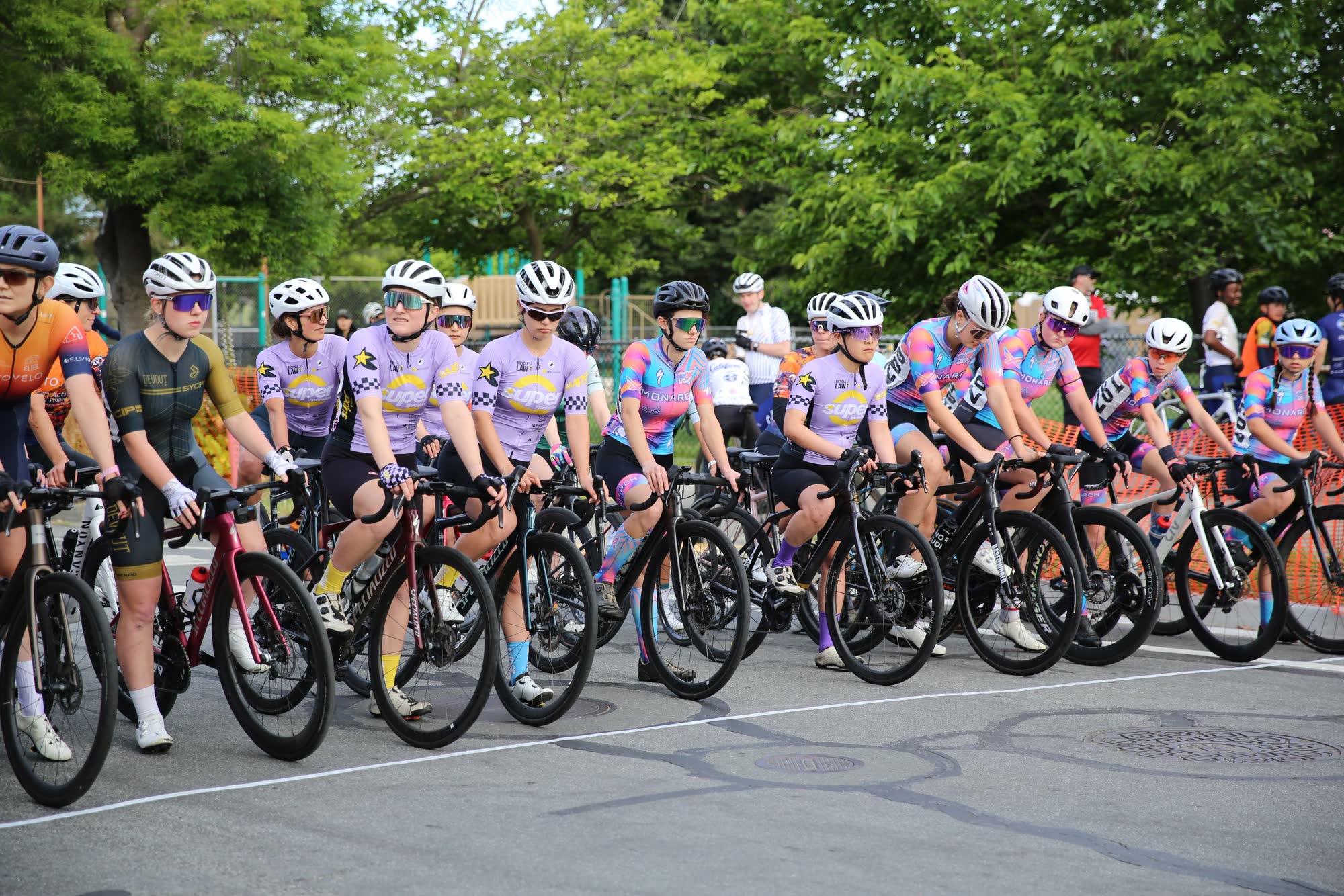
Racers are called to staging, officials give instructions, riders line up, and the race starts. Listen closely to the instructions: under USA Cycling rules, officials explain before the start how lapped riders and riders who fall behind will be handled.
The first few laps can feel chaotic, because everyone is fresh and trying to find position. Don't panic, don't make sudden movements, and don't feel you have to get to the front right away. Settle into the race safely.
Getting dropped is not failure
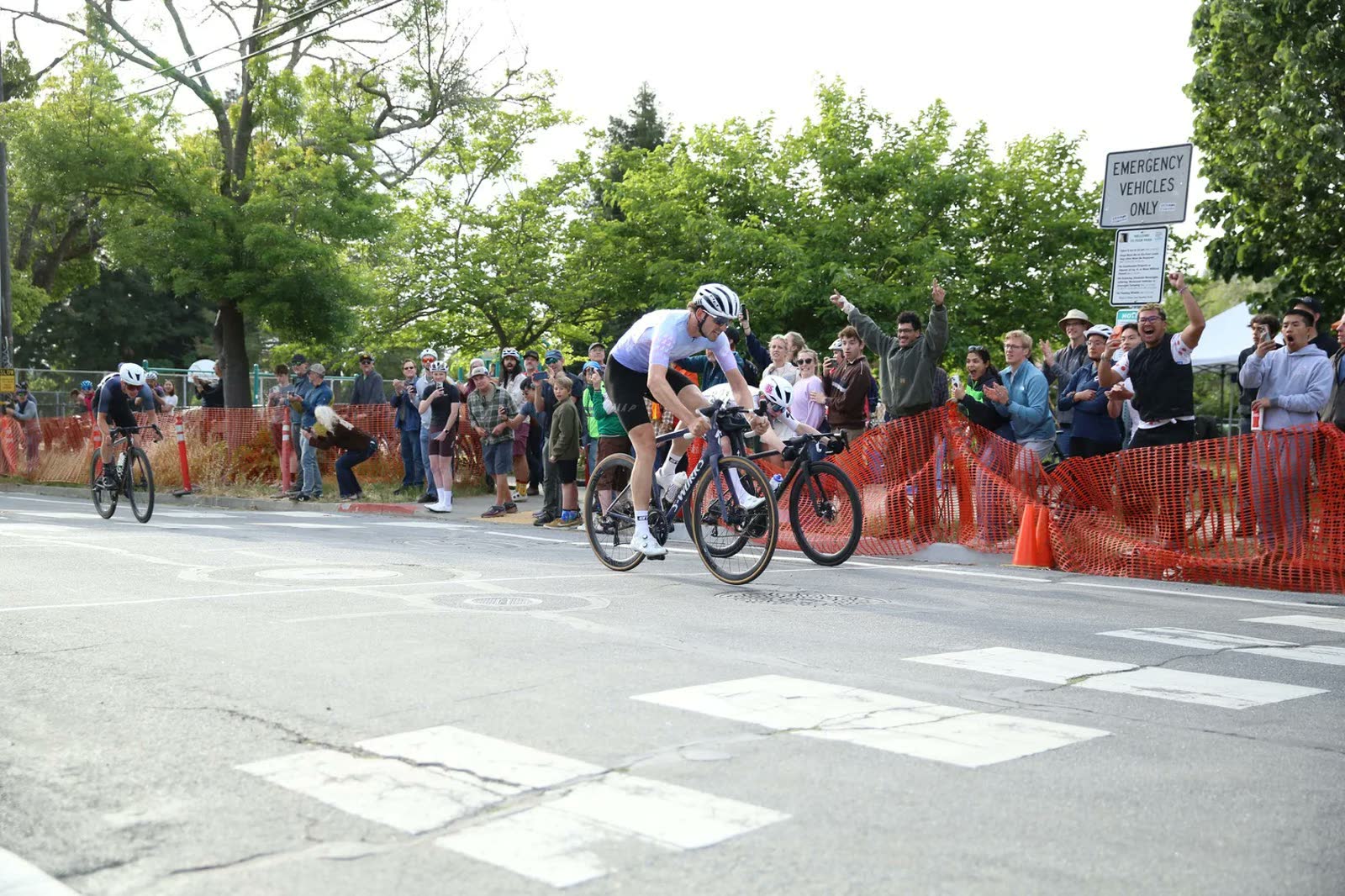
Getting dropped means a gap opens between you and the field and you can't close it. It happens, especially in first races. What happens next depends on the race: under USA Cycling rules, officials either remove riders who fall too far behind or let lapped riders keep racing, and they explain which before the start. Either way, follow their instructions. A rider who has lost contact and is caught by a breakaway may not lead it.
Then use it. Where did the gap open: a corner, an acceleration, your position, your fitness, a technical mistake? That's what to work on next.
Getting dropped from your first crit doesn't mean you aren't a bike racer. It means you just learned what bike racing asks of you.
What does "getting pulled" mean?
Officials can remove riders from a criterium, usually because they've fallen far enough behind to be out of contention. It's how races stay safe and on schedule, not a penalty. If you're pulled, follow the officials' instructions, leave the course where they tell you, and don't re-enter the race. Under USA Cycling rules, pulled riders can still be placed, by the distance they covered and their order among the riders pulled that lap.
Primes, breakaways, lead-outs and the bell
Primes
A prime, pronounced "preem," is a prize sprint in the middle of the race. Winning one doesn't mean the race is over.
Breakaways
A breakaway is one or more racers who get away from the main field and try to stay ahead. The field may chase them down, or let them go if no one wants to spend the energy.
Lead-outs
Near a sprint, teammates may ride hard at the front to position their sprinter and deliver them toward the finish.
Bells, lap cards and officials
Officials and race staff communicate with lap cards, bells, announcements and spoken instructions. Don't assume every bell means the same thing: a bell rings the lap before a prime, and also for the last lap, when the lap card shows "1."
The final lap
Once the final lap is signaled, the pace can rise sharply and position gets contested. In your first crit, don't make unsafe moves because it's the last lap. Your goal is still to finish safely and learn.
What to bring
Required
- A mechanically sound bike.
- A helmet that meets USA Cycling's standards. Berkeley Streets requires ANSI or Snell certified helmets for all riders.
- A USA Cycling license, annual or one-day, and your registration.
- A race jersey and shorts: jerseys are required in USA Cycling races.
- Your race number, pinned where the officials tell you.
Nice to have
- Cycling shoes, water, and food for before the race.
- Safety pins, in case they aren't provided.
- Warm-up clothing and sunscreen.
- A pump, basic tools and a spare tube.
- Spare wheels, where the race offers a free lap: Berkeley Streets has, so bring them.
Check your bike before race morning
Check your tires and tire pressure, brakes, shifting, chain, wheels, thru-axles or skewers, cleats, and electronic shifting batteries a few days before. Race morning is a terrible time to discover your Di2 battery is dead.
How early should I arrive?
Give yourself much more time than you think you'll need. You may have to park, find registration, check in, sort out a license, sign waivers, pin numbers, use the restroom, look at the course, warm up and find staging. At Berkeley Streets, race-day check-in has opened at 6:50 a.m. and closed 15 minutes before each race.
Berkeley Omnium registration guide →
Find your race's start time:
Berkeley Streets race schedule →
Study the course before you get there:
Racing your first crit at Berkeley Streets?
It's one of the best reasons to arrive prepared and early. Fields that include Novice riders are also capped at 75 under USA Cycling rules, and the most recent Berkeley Streets Novice race was 30 minutes long.
Assertive doesn't mean aggressive
| Assertive is | Aggressive is |
|---|---|
| Being deliberate | Bullying other riders |
| Holding a reasonable position | Passing dangerously |
| Riding predictably | Chopping across someone's wheel |
| Communicating | Forcing gaps that aren't there |
| Not giving away every wheel | Making unpredictable moves |
Ride like you belong there, not like everyone else needs to get out of your way.
I'm nervous. Should I still race?
Some nerves are expected: racing brings speed, close quarters, competition and unfamiliar procedures. Preparation is what shrinks them. Before you race, understand the course, the staging, and how a pack behaves; make sure your bike works; arrive early; do the Beginner Race Program if you're eligible; and ask officials when you're not sure. You don't need to know everything before your first race, but you should know the fundamentals that let you take part safely.
A good first crit
- I started.
- I rode predictably.
- I got through the corners safely.
- I learned how the field moves.
- I figured out what to work on.
- I want to race again.
A great result on top of that? Even better. But it's not the only measure of a successful first race.
Common first-criterium mistakes
- Starting too hard: adrenaline is powerful, and the first laps aren't the finish.
- Sitting at the very back: that's where the accordion makes every corner a hard acceleration.
- Staring at the wheel directly ahead: it hides what's coming.
- Overlapping wheels: an unnecessary risk.
- Braking too much in corners: it costs momentum and affects the riders behind you.
- Trying to win every corner: you don't need to.
- Treating every acceleration like the winning move: crits have lots of them.
- Thinking getting dropped means you shouldn't race: it doesn't.
- Forgetting to eat and drink beforehand: feeding during a crit isn't allowed unless the chief referee approves it.
- Arriving late: it adds stress before the race even starts.
First crit terminology
| Term | Meaning |
|---|---|
| Peloton | The main group of racers. |
| Prime ("preem") | A prize sprint in the middle of the race. |
| Breakaway | One or more racers ahead of the main field. |
| Attack | An acceleration meant to get away from the group. |
| Lead-out | Teammates riding hard to position their sprinter. |
| Draft | Less wind resistance from riding behind another rider. |
| Lapped | Caught by the race leaders after falling a lap behind. |
| Pulled | Removed from the race by officials under the race's procedures. |
| Bell lap | The final lap: a bell rings and the lap card shows 1. |
The full story on one of the most misunderstood terms:
After your first race
Don't just pack the car and forget it. Ask where the race felt hardest: the corners, the repeated accelerations, positioning, riding close to others, fitness, the sprint, or understanding what was going on? That answer tells you what to practice next.
Moving up through the categories is the next step:
Cycling categories explained →
Racing for a college team or a junior program? There's a path for you, too.
How to start collegiate bike racing in California →
For junior racers and their families:
Ready to try your first crit?
Berkeley Streets has fields for new, junior and collegiate racers, and the Beginner Race Program for Junior and Novice entries, including collegiate Novice.
Explore the Berkeley Streets Criterium →
Get a feel for the course before your first lap counts:
See the Beginner Race Program →
Pre-registration, day-of entry, licenses and junior waivers:
Questions
Your first criterium race: everything you need to know before the start: FAQ
What is a criterium race?
A bicycle race held on a short circuit, closed to traffic, that racers complete repeatedly for a set time or number of laps.
Are criteriums good for beginner cyclists?
They can be. Novice fields and programs like the Berkeley Streets Beginner Race Program are built as entry points, but you should already be comfortable riding in a group and follow the event's requirements.
Do you need a high FTP to race a criterium?
No. No specific FTP or power number decides whether you can start racing.
Is criterium racing only about sprinting?
No. Positioning, cornering, drafting, repeated acceleration, race awareness and fitness all matter.
What happens if I get dropped in a criterium?
Follow the officials' instructions. Depending on the method they announce before the start, dropped riders may be pulled or allowed to keep racing.
What does getting pulled mean?
Officials remove a racer from the race, usually for falling too far behind. It's race management, not a penalty, and pulled riders can still be placed.
What is a prime?
A prize sprint in the middle of a criterium, pronounced "preem." The race continues afterward.
What is a prime? →What should I bring to my first criterium?
A race-ready bike, a helmet that meets the event's standard, your USA Cycling license, race kit and your number, plus water, food, warm-up clothes and spare wheels if there's a free lap.
How early should I arrive for my first criterium?
Much earlier than you think: you need time to park, check in, sort out your license, pin your number, warm up and find staging. Check-in often closes before each race.
How do I prepare for my first criterium?
Learn the course, prepare your bike, practice pack skills on group rides, arrive early, warm up, and take part in any beginner instruction, such as the Berkeley Streets Beginner Race Program.
The Beginner Race Program →