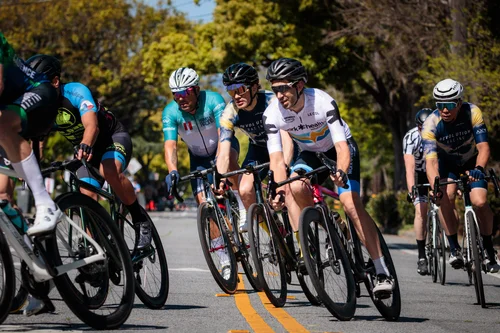
Criterium Racing 101
What is a prime in a criterium? A beginner's guide
No, it's not pronounced "prime." Here's what a prime is, why racers sprint for it in the middle of the race, and what to watch for.
Primes at a glance
- Pronounced
- "Preem"
- What it is
- A prize sprint during a criterium, before the final finish
- Signal
- A bell rings the lap before the prime sprint
- Does it end the race?
- No. The race keeps going.
- Berkeley Omnium points
- No
The short answer
A prime, pronounced "preem," is an intermediate prize awarded during a criterium bicycle race. A bell rings the lap before, then racers compete to cross the designated prime line first and the winner takes the announced prize. Winning a prime does not end the race: the criterium continues until the final finish.
No, it's not pronounced "prime"
In bike racing, prime is said "preem," not "prime" like Amazon Prime. Say "prime" at your first criterium and everyone will still know what you mean. But if you want to sound like you've been around bike racing for a while, say "preem."
What is a prime?
A prime is a prize that racers can win during a criterium, before the actual finish. The announcer or officials signal that a prime is coming, racers compete to be first across the prime line on that lap, and the winner gets the announced prize. Then the race continues.
- Race starts
- Prime announced
- Bell ringsOn the lap before the prime sprint.
- Racers sprint for the prime
- Prime winner crosses the line
- The race keeps going
- Final race finishWhere the race is actually won.
What can you win?
It depends on the race and its sponsors. A prime might be cash, merchandise, cycling products, a gift card or another sponsor prize. Listen to the announcer for what each prime is worth. Under USA Cycling rules, youth races and races only for Novice riders can't award prizes with commercial value, only things like trophies, medals, ribbons and certificates.
How does a prime work?
The field is racing. The announcer calls "Prime next lap!" and, under USA Cycling rules, a bell rings on the lap before the prime sprint, at the line where the prime will be decided. That line doesn't have to be the finish line. Now everyone knows there's something to race for.
- Riders who want the prize start moving toward the front.
- Teams may organize around a teammate.
- Someone may attack before the sprint.
- The field speeds up.
- The first eligible rider across the prime line wins the prime.
- Then the race continues.
Primes can be planned for certain laps or called on the spot under the chief referee's supervision. Lapped riders usually aren't eligible, and a rider who wins a prime keeps it even if they later drop out. Exact procedures vary, so the officials and announcements at each race have the final word.
Why is someone ringing a bell?
The bell is one of the classic sounds of criterium racing, and it can mean different things. It rings the lap before a prime sprint. It also rings for the last lap of the race, when the lap card shows "1." Don't assume every bell means the same thing: listen to the announcer and watch the lap cards.
| Compared on | Prime bell | Final-lap bell |
|---|---|---|
| What it means | A prime sprint next time around | The last lap of the race |
| Lap card | Laps still remaining | Shows 1 |
| After the sprint | The race keeps going | The race is over |
So if you see a huge sprint in the middle of a crit and wonder whether they just finished: probably not. Check the lap card.
Primes change the race
A prime isn't just a prize. Every racer has to decide: spend energy trying to win it, or save the legs for the finish? A sprinter may want the prize. A breakaway may already be in the perfect position to take it. A team may lead out a teammate. Someone may use the acceleration to attack. Another racer may ignore it completely and conserve energy.
What happens after the prime?
New racers focus on reaching the prime line. Experienced racers are also thinking about what happens right after. A prime sprint is a hard acceleration: some riders spend a lot, the field stretches out, small gaps open, and some riders sit up once the sprint is over. That's an opening for someone else to attack.
Sometimes the most important move isn't the sprint for the prime. It's the attack five seconds after it.
Example: a $50 prime
Imagine the announcer calls "$50 prime next lap!" in an open race. A few riders move to the front, the pace rises, and two riders launch their sprint. Racer A crosses the prime line first and wins the $50. But the criterium isn't over. The field keeps racing, and twenty minutes later Racer B wins the final sprint.
Racer A won the prime. Racer B won the bike race. (This is a made-up example, not a Berkeley Streets prize.)
Can a breakaway win a prime?
Yes. Under USA Cycling rules, primes can be for the lead riders or for any group. If a breakaway is ahead when a prime is contested, its riders may be sprinting against each other for it. That creates its own tactics: do they keep cooperating, does someone stop pulling to save energy, does someone attack, or do they all sprint?
Do primes count toward the Berkeley Omnium?
No. Under the current Berkeley Omnium scoring rules, there are no prime points. A racer can win a prime at the Berkeley Streets Criterium, which may still offer primes for other prizes, but it doesn't add to their Omnium score. Berkeley Omnium points come from a racer's final placing in the Berkeley Hills Road Race and the Berkeley Streets Criterium.
How Berkeley Omnium scoring works →
Want to see what your placings add up to?
Should you go for it?
There isn't one right answer. It depends on:
- Your goals for the race.
- Your strengths.
- Your position in the field.
- How much energy you have.
- How much racing is left.
- Whether you're in a breakaway.
- Your team's plan.
- What the prime is worth.
- Whether the final result matters more to you.
Your first crit? Don't panic when the bell rings.
In your first criterium, pay attention to the officials, the lap cards, the announcer and the experienced racers around you. Don't assume every acceleration means the finish, or that every bell means the race is over. And you don't have to contest every prime: a good plan for a first race can simply be to watch how the field reacts.
The Berkeley Streets Beginner Race Program →
New to criterium racing? Start with the complete beginner guide.
How to watch a prime
When you hear the announcer call a prime, watch the front of the field:
- Riders moving up.
- Teammates organizing.
- Sudden attacks.
- Riders fighting for position.
- The sprint itself.
- What happens right after it.
Don't stop watching when someone wins the prime. The acceleration often sets up the next important move in the race.
Prime vs. race win
| Compared on | Prime | Race win |
|---|---|---|
| When | During the race | At the final finish |
| Does the race end? | No | Yes |
| Prize | Often, as announced | Yes, based on the event's awards |
| Berkeley Omnium points | No | Your final placing earns Omnium points |
| Why it matters | It can change the race | It decides the result |
More criterium racing 101
How criteriums work, from the course to the final sprint:
How a crit compares with a road race:
What field labels like 4/Novice and P/1/2 mean:
Questions
What is a prime in a criterium? A beginner's guide: FAQ
What is a prime in criterium racing?
A prime, pronounced "preem," is an intermediate prize contested during a criterium, before the final race finish.
How do you pronounce prime in cycling?
"Preem."
Does a prime end the race?
No. The race continues after the prime.
Does winning a prime mean you won the criterium?
No. The criterium is won at the final finish.
What can you win in a prime?
Depending on the event, cash, merchandise, sponsor prizes or other awards. Youth races and Novice-only races can only award things like trophies, medals and ribbons.
Why do racers sprint for primes?
To win the prize and, depending on the race, for tactics: a prime can set up an attack, test the field or help a breakaway.
Do prime points count toward the Berkeley Omnium?
No. There are no prime points in the current Berkeley Omnium scoring; Omnium points come from final placings.
How Berkeley Omnium scoring works →What happens after a prime?
The race continues, and the acceleration from the prime can create attacks, gaps or breakaways.